Overview: For years, the success of eLearning experiences has been gauged using common metrics: course completion rates, learning satisfaction scores, and tests.
Learning Success Through Performance
Although many metrics offer superficial answers, they don’t address the most important business question: “How quickly can learners carry out their tasks?” This is where time-to-competency, or TTC, adds significant value. Rather than looking at the learning activity, it focuses on learning impact by determining how long it takes a learner to reach an acceptable level of competency.
What Is Time-to-Competency?
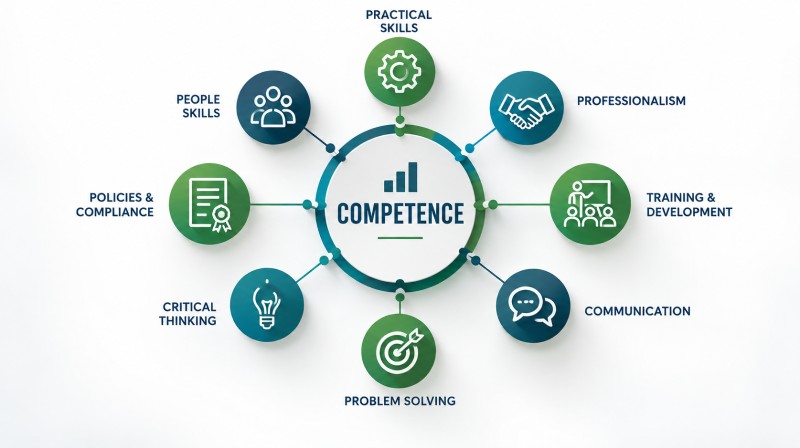
Time-to-competency is the time span between when a learner starts training and when they can deliver all necessary tasks to specified performance requirements. Unlike completion-based metrics, it values capability rather than consumption. Competency is not mastery. Competency is the capacity to apply knowledge and skills correctly in an independent and assured manner. Thus, the TTC measures the gap between learning and performance.
Why Traditional Learning Metrics Fall Short
Completion rates reflect attendance, not effectiveness. Someone can finish a course and still lack the confidence or skills to apply it at work. Also, quizzes test short-term retention, not application over time.
Learner satisfaction surveys matter, but they reflect perception rather than performance. A course might simultaneously be engaging and ineffective or challenging and influential. Not one of these measures shows how learning has added value to business productivity and quality. In time-to-competency, the emphasis moves from “did they complete the course?” to “can they do the job?”
Why Time-to-Competency Matters to the Business
In regard to business, it is noted that TTC impacts risk management and operational efficiency directly through:
- Reduced onboarding time
Fast onboarding of new employees translates to the employee starting to generate revenue sooner. - Increased performance
When employees develop competency quicker, there are fewer mistakes and less need for supervision. Skill gaps are bridged as TTC points out areas where learners need improvement. - Better learning investments
The organization can assess which learning programs facilitate faster performance improvements.
In regulated industries, a smaller, documented TTC may also reduce compliance risks by ensuring workers have the appropriate skills for critical tasks.
Defining Competency: The Critical First Step
Measuring time-to-competency requires defining what competency entails. This is where companies have traditionally struggled. Competency should be defined in partnership with:
- Subject Matter Experts (SMEs)
- Line managers
- High-performing workers
Effective competency definitions are observable and measurable. Instead of focusing on knowledge, competency definitions should focus on actions and outcomes. For example, “can troubleshoot customer problems on their own within service levels” is more measurable than “is familiar with the product.” Poorly defined competencies lead to unreliable time-to-competency measurements.
Method for Measuring Time-to-Competency
While TTC measurement does not involve complicated systems, it does require design. Methods used include:
- Performance checklist
The manager verifies that learners can do the task independently. - On-the-job evaluation
Job tasks are assessed as they are performed in real work conditions. - Simulation evaluations
Skills are shown in a practical setting. - Operational Key Performance Indicators
Operational Key Performance Indicators include error rates, productivity, and customer satisfaction.
The clock begins when learning starts and ends when competency is demonstrated, not when a course ends.
Designing Learning to Reduce Time-to-Competency
Once you track TTC, you can optimize learning strategies to reduce it. Key design principles include:
- Role-based learning
Focus only on skills required for the role, eliminating unnecessary content. - Practice-driven design
Prioritize scenarios, simulations, and hands-on application. - Performance support
Provide job aids, checklists, and micro-resources at the moment of need. - Blended reinforcement
Combine digital learning with coaching, feedback, and peer support.
View learning as part of a broader performance ecosystem, not a standalone event.
Common Mistakes When Using Time-to-Competency
Organizations often undermine TTC by:
- Treating competency as a one-time milestone rather than a sustained state.
- Relying solely on self-assessments.
- Ignoring contextual factors such as manager support or workload.
- Measuring too early, before performance stabilizes.
Time-to-competency works best when combined with ongoing performance monitoring and continuous improvement.
From Learning Metrics to Performance Metrics
Time-to-competency is a paradigm shift in thinking. The purpose of learning is to build competency rather than serve as an end goal in itself. For L&D professionals, it builds credibility by focusing on learning outcomes that align with organizational goals. In a world where skills change rapidly and productivity pressures continue to escalate, organizations can no longer afford to measure learning in silos. The question now isn’t how much learning took place but how fast its impact was felt. Time-to-competency is more than a statistic. It is a paradigm that makes learning itself more meaningful.
By Satyabrata Das